
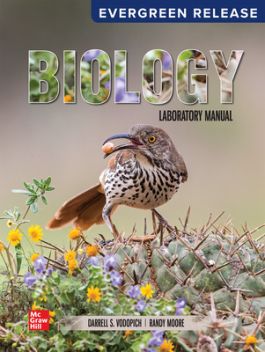
Biology Laboratory Manual: 2025 Release
1266322299
·
9781266322297
The Biology Laboratory Manual by Vodopich and Moore was designed for an introductory biology course with a broad survey of basic laboratory techniques. The experiments and procedures are simple, safe, easy to perform, and especially appropriate for l…
Read More
Request More Info
Receive via shipping:
Colour, print bound version of the complete text
- 1. Scientific Method: The Process of Science
- 2. Measurements in Biology: The Metric System and Data Analysis
- 3. The Microscope: Basic Skills of Light Microscopy
- 4. The Cell: Structure and Function
- 5. Solutions, Acids, and Bases: The pH Scale
- 6. Biologically Important Molecules: Carbohydrates, Proteins, Lipids, and Nucleic Acids
- 7. Separating Organic Compounds: Column Chromatography, Paper Chromatography, and Gel Electrophoresis
- 8. Spectrophotometry: Identifying Solutes and Determining Their Concentration
- 9. Diffusion and Osmosis: Passive Movement of Molecules in Biological Systems
- 10. Cellular Membranes: Effects of Physical and Chemical Stress
- 11. Enzymes: Factors Affecting the Rate of Activity
- 12. Respiration: Aerobic and Anaerobic Oxidation of Organic Molecules
- 13. Photosynthesis: Pigment Separation, Starch Production, and CO2 Uptake
- 14. Mitosis: Replication of Eukaryotic Cells
- 15. Meiosis: Reduction Division and Gametogenesis
- 16. Molecular Biology and Biotechnology: DNA Isolation and Genetic Transformation
- 17. Genetics: The Principles of Mendel
- 18. Evolution: Natural Selection and Morphological Change in Green Algae
- 19. Human Evolution: Skull Examination
- 20. Ecology: Diversity and Interaction in Plant Communities
- 21. Community Succession
- 22. Population Growth: Limitations of the Environment
- 23. Pollution: The Effects of Chemical, Thermal, and Acidic Pollution
- 24. Survey of Prokaryotes: Domains Archaea and Bacteria
- 25. Survey of Protists: Algal Autotrophs
- 26. Survey of Protists: Protozoan Heterotrophs
- 27. Survey of the Kingdom Fungi: Molds, Sac Fungi, Mushrooms, and Lichens
- 28. Survey of the Plant Kingdom: Liverworts, Mosses, and Hornworts of Phyla Hepatophyta, Bryophyta, and Anthocerophyta
- 29. Survey of the Plant Kingdom: Seedless Vascular Plants of Phyla Pterophyta and Lycophyta
- 30. Survey of the Plant Kingdom: Gymnosperms of Phyla Cycadophyta, Ginkgophyta, Coniferophyta, and Gnetophyta
- 31. Survey of the Plant Kingdom: Angiosperms
- 32. Plant Anatomy: Vegetative Structure of Vascular Plants
- 33. Plant Physiology: Transpiration
- 34. Plant Physiology: Tropisms, Nutrition, and Growth Regulators
- 35. Bioassay: Measuring Physiologically Active Substances
- 36. Survey of the Animal Kingdom: Phyla Porifera and Cnidaria
- 37. Survey of the Animal Kingdom: Phyla Platyhelminthes and Mollusca
- 38. Survey of the Animal Kingdom: Phyla Annelida and Nematoda
- 39. Survey of the Animal Kingdom: Phylum Arthropoda
- 40. Survey of the Animal Kingdom: Phyla Echinodermata and Chordata
- 41. Vertebrate Animal Tissues: Epithelial, Connective, Muscular, and Nervous Tissues
- 42. Human Biology: The Human Skeletal System
- 43. Human Biology: Muscles and Muscle Contraction
- 44. Human Biology: Breathing
- 45. Human Biology: Circulation and Blood Pressure
- 46. Human Biology: Sensory Perception
- 47. Vertebrate Anatomy: External Features and Skeletal System of the Rat
- 48. Vertebrate Anatomy: Muscles and Internal Organs of the Rat
- 49. Vertebrate Anatomy: Urogenital and Circulatory Systems of the Rat
- 50. Embryology: Comparative Morphologies and Strategies of Development
- 51. Animal Behavior: Taxis, Kinesis, and Agonistic Behavior
- Appendix I- Dissection of a Fetal Pig
- Appendix II- Conversion of Metric Units to English Units
The Biology Laboratory Manual by Vodopich and Moore was designed for an introductory biology course with a broad survey of basic laboratory techniques. The experiments and procedures are simple, safe, easy to perform, and especially appropriate for large classes. Few experiments require more than one class meeting to complete the procedure. Each exercise includes many photographs, traditional topics, and experiments that help students learn about life. Procedures within each exercise are numerous and discrete so that an exercise can be tailored to the needs of the students, the style of the instructor, and the facilities available.